Monday, November 12, 2007

mosaic stepping stones evaluation process

The Parks Childrens House Creative Network group includes participants who are new mothers seeking support with their first child - mostly quite young, some with physical or mental health issues, some have partners/some are single, generally low income, maybe housing trust clients, perhaps social or work skills need developing - the changes may be slow but significant. They are all justifiably proud of the art work they have created over the past three years of the Parks Helix Project (photographic pet safety posters, calendars, play area design, marine ply silhouette cut-outs for building façade, mosaic seat and now mosaic stepping stones) and now want their group to continue on a self-managed basis to gain funding and do more art projects.

Part of the evaluation we were asked to do on this project was to identify how the project has fostered health and wellbeing. I used a questionnaire to gather data from the participants and also initiated conversations about the subject. Questions included: What was the best part of the project? What was the worst part of the project? How could the project be improved? How can this group keep going in the future? Would you be a part of it? What difference has this project made in your life? Has this project changed how you think and feel about your future?


I had a conversation with a peer support trainee (previously a participant who I will call N) who was working with our project about how being involved might cause changes in individuals. Over the last 3 years, while N participated in different stages of the Parks Helix Project, I have observed that N's confidence has grown significantly - learning a variety of new arts based skills, participating increasingly confidently in a group situation, has attended training in peer support, is now working in a paid support trainee role - which includes greater responsibilities, and overcoming personal barriers. N's response was that she now feels more creative and confident, and would like to do more arts based projects, which was a fairly typical response. Others expressed pleasure at being part of artmaking, and also enjoyed the walking aspects of the sessions.

I read an article about the Artful Dodgers Studio, and 'dynamic observation approach', using identified indicators to monitor individual progress during participation in the ongoing program. One interesting approach was for the worker to compile a series of 'snap-shots' or observational report every couple of months to track changes in a participant, which then provided a detailed account of each participant's developmental journey. (Artwork magazine, issue 59, Sept 2004, p28-31) This approach resonates with and articulates the approach I used as an artsworker during the Parks Helix Project initiatives.

As this stage was focussed on creating art for a community walking trail, part of every workshop involved walking for at least part of the session. We also took a picnic to the parks a few times, which were enjoyed by the participants and their children.

The 'big books' were the main evaluation and documentation of the initiative…recorded in an A3 artist journal. more on this useful tool soon.

Friday, November 9, 2007

photographic seats initiative intro

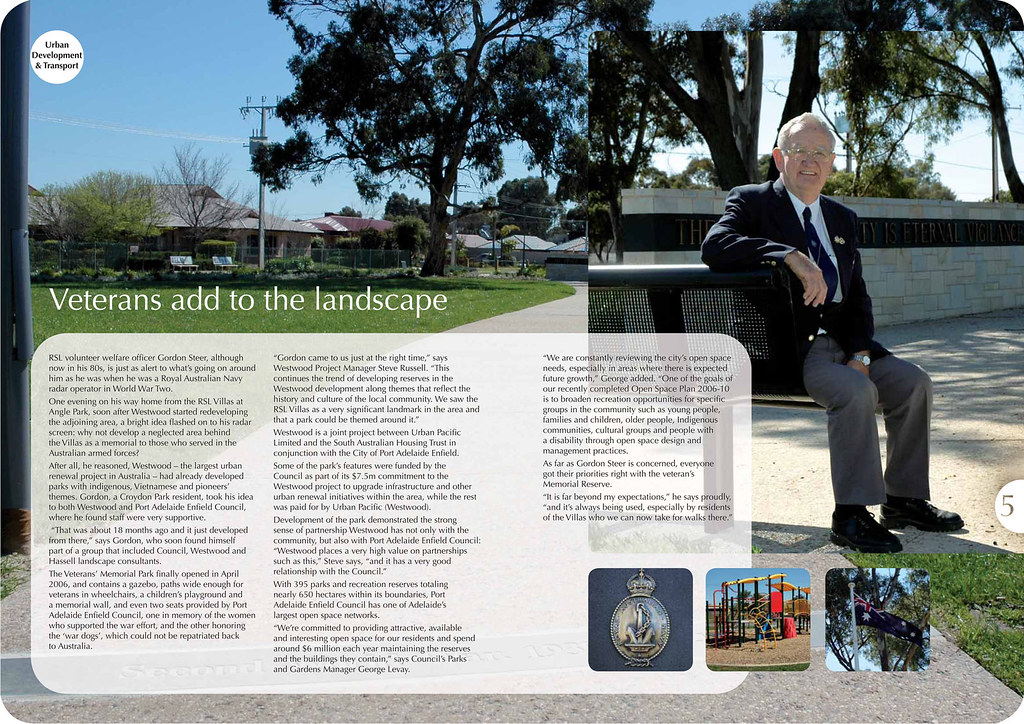
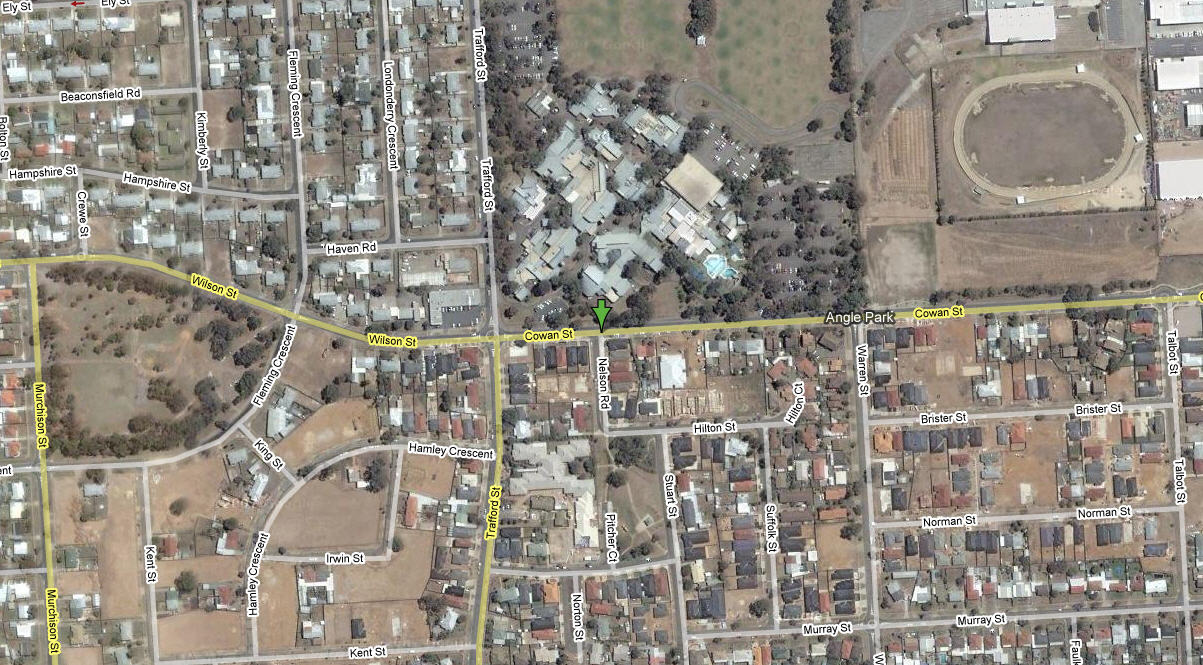
There had been an installation of two seats with photographic panels installed into the redeveloped Veterans Memorial Reserve in Nelson St, Angle Park, as part of an earlier project to commemorate Australians' contribution to various conflicts.

These seats were used as a starting point for a commissioned initiative for the Parks Helix Project, overseen by the City of Port Adelaide Enfield. I was engaged initially as the project coordinator, then as the artist. The first stage of my role included research and development of the seat design, sourcing manufacturers and obtaining quotes and design specifications for approval by the Parks Helix Project Management Group and the City of Port Adelaide Enfield Public Art Committee. Many ideas were explored before narrowing the options to the final choice. Some of the challenges were budget considerations, time constraints, the requirement for a photographic panel to be part of the seat, desire for a 'classy' design and perceptions about what would be acceptable to the local community.

The concept of placing photographic seats along the walking trail at two specified places on Stuart St and Parker St, provides opportunities to create an artistic reflection on the three years of the Parks Helix project. It is also a chance to share the connections created within the community, while providing a space to sit, relax and rest.

The photographic panels convey a sense of space and place, reflecting on the changes stimulated by the Parks Helix Project. The images draw on existing imagery from project initiatives and incorporate new images inspired by the walking trail, which include elements of mapping.

The seats, photographic panels and concrete slabs all incorporate complementary elements to create one piece of art.

Saturday, November 3, 2007

community cultural development

my student experience with the Parks Helix Project inspired me to study further in the field of community cultural development, and i enrolled in the Graduate Diploma course with Community Arts Network of South Australia (CAN SA). my experiences working with the community on this project were positively informed by what i learned while studying - the theory applied in practice.

Community cultural development is a broad field that generally involves creating positive change using the arts as a means of expression. “Community cultural development (ccd) is the essential ingredient for communities to keep the ties between art, culture, health, education and environment together and is the essential ingredient to maintaining human dignity.” (Lewis & Nankivell 2003 p17) We all have the capability for creative expression, in whatever form; everyone should have the opportunity to experience learning new skills in a supportive, non-discriminatory environment; and positive changes come from this experience. All people want to tell stories, share experiences, create connections – be valued as individuals, and useful members of society.

Several studies on the impact of the arts are summarised in the publication ‘Art and Wellbeing’ of which all demonstrate the positive outcomes from community cultural development principles are combined with the community being involved in various art forms as a form of expression. “Community-based creative processes, when embedded into an agency’s policies and strategies, can be very powerful in strengthening the knowledge, engagement, social capital and leadership required to achieve policy objectives” (Mills & Brown 2004 p4).

The common denominators of productive community cultural development can be described by using various indicators of success, from ‘deepening and broadening of their cultural knowledge’ to ‘develop a mutually meaningful, reciprocal and collaborative relationship’. A feeling of satisfaction increased self-esteem and confidence, while becoming ‘co-directors’ of the projects. (Adams & Goldbard. 2001. p67) Building networks is an organic process; constantly growing, changing, sharing, and creating new connections.

Studies indicate that people who are “well-connected” generally are healthier, happier and more productive, the benefits of which are seen on both personal level and also within the broader community; for example, healthy people are less likely to need health and welfare services. Some studies have linked social capital with productivity and economic growth, and even with reducing child abuse. The CCD process could be compared to a tree, with projects as branches coming out from the community resulting in leaves, flowers and ultimately fruit, from which sprouts new plants, and the cycle continues. Funding and government policy should nurture and fertilise the process, enabling new growth on many levels.

Why ‘The Arts’?
“Art is like the underlying soul of the community, whose survival and well being is dependant on the health, environment, education and the culture. Without art, the community doesn’t exist… it keeps the community healthy and happy”(Lewis & Nankivell 2003 p17). There is an artform to suit everyone – from simple to advanced levels; group projects or individual work; 2D or 3D; messy or clean; figurative to abstract; political or personal – the list is endless. The common link between these forms is the desire to creatively communicate a message.

The arts are an ‘instrumental’ tool for education, raising awareness, building self-confidence, enhancing skills, self-expression, and creating positive connections, yet can as well play a ‘transformational’ role in changing attitudes and policies. Even when the same artists use the same project concept – if the community is different, then the feel, outcome and even process will differ. “Artists are catalysts: that is what they do. If artists are anything at all, they are the agents of change. They change the way we see, the way we hear, the way we feel, the way we imagine, the way we discriminate.” (Battersby 2005 p10 online)

Using a broad theme for a project allows many different views and forms of expression to be used, while still creating a feeling of community. The Parks Helix Project theme of ‘Safety’ was chosen as a link between the partner initiatives; to counteract the usual negative media coverage of the area by highlighting the positives; and to challenge any fear of the unknown redevelopment may cause to long-term residents.

References
Adams, Don & Goldbard, Arlene. 2001. Creative Community: The Art of Cultural Development. The Rockefeller Foundation, New York
Battersby, Dr Jean. 2005. Innovation in the Arts. transcript from “The Imagination and the Audience: commissioning for creativity”. Alfred Deakin Innovation Lecture Series, Melbourne. 7 May, accessed online. http://www.deakinlectures.com.au/pdf/battersby_j.pdf
Lewis, Tom E. & Nankivell, Jayne. 2003. ‘Slow Tucker Long Yarn’. Artwork Magazine, CANSA. Issue 57 – December. p17.
Mills, Deborah & Brown, Paul. 2004. Art and Wellbeing: a guide to the connections between Community Cultural Development and Health, Ecologically Sustainable Development, Public Housing and Place, Rural Revitalisation, Community Strengthening, Active Citizenship, Social Inclusion and Cultural Diversity. Australia Council for the Arts, Sydney. p4.

Friday, November 2, 2007

a little about my background with the Parks Helix Project

I graduated with a visual arts degree from UniSA School of Art in 2004, majoring in photography. Part of my chosen study path during this time included two Internship Program student placements at the Parks Community Centre to explore the arts in the community, in addition to the fine arts focus. Firstly, I shadowed Matthew Ives, then arts officer for the City of Port Adelaide Enfield. At that time, he was developing the concept of what was to become the Parks Helix Project with state funding body Arts SA. I was able to observe the process of inviting diverse organisations to become part of an arts based community cultural development activity, a new experience for some of the partner organisations.

The following year (Honours), I chose to further develop my experience in community arts by being placed with one of the Parks Helix Project partner organisations - Parenting Network. Mentored by Suzanne Laslett (an outstanding photographic artist), we worked with a young mothers group called CCC which met every Thursday. Photography was chosen as the medium to express the concept of pets and children and safety. During a series of workshops, we explored photographic techniques using disposable film cameras, which participants could take home with them. Once the images were developed, the group chose the one of their images which shared a message of pets and safety -then we discussed possible captions. The photographs were scanned, captions added and five posters were printed.


These posters were exhibited as part of the Pathways & Connections display at Axis Gallery in April 2005, along with images of outcomes created by the other six project partners. They are now on display in the Parks Childrens House, which accommodates the Parenting Network organisation along with other child focused services.

I was privileged to work with a group of wonderful women (formed from the first stage of the Parks Helix Project) on several initiatives during the 3 years of the project. The mosaic stepping stones was the focus for the final stage created by this group, and are part of the Walking Connection walking trail. More to follow on this initiative soon…

Thursday, October 25, 2007

year 3 - The Walking Connection walking trail

a brochure was created to guide community members along the walking trail, highlighting art along the way...


Wednesday, October 17, 2007

Arts Projects developed over the 3 years of The Parks Helix Project

by Robert Petchell, project coordinator

In Years 1 & 2 the Project Partners developed individual art project initiatives…

Year 1 - May 2004 - June 2003
Parenting Network
- Digital photography project creating posters on the theme of pets and safety around children. Also worked with the architect for the Parks Childrens House building to develop ideas for the play area. With artists Suzanne Laslett, Karen Tenni
Parks Community Health Service - Digital Film Project created four short films on the them 'Stories from the Parks'. With artists Carol Omer, David Salomon.
Port Adelaide Enfield Council - Project focused on residents over 50 years of age, using an actor to create a series of monologues based on interview with residents and a knitting project that created a knitted tree with sound & image installation that explored the theme of 'what makes you feel safer in your community'. With artists Bridget Walters, Evelyn Roth
Ridley Grove School R-7 - created decorated fence panels and stobie poles as the first stage of connecting the school with the recently created Mikawomma Reserve that the school was also involved in developing. With artist Sandy Elverd
Westwood - concept development of a Walking Trail in the Parks area involving development of artistic ideas and themes under the name of 'The Walking Connection'. With artist Bob Daly

Year 2 - July 2005 - June 2006
Parenting Network
- created large silhouettes out of marine ply that were attached to the front of the Parks Childrens House and mosaic panels based on the theme of nursery rhymes added to a low wall at the entrance. With artists Karen Tenni, Bridgette Minuzzo
Parks Community Health Service - developed 2 longer films as part of 'Stories from The Parks', with one focusing on the issues and experiences of relocation as part of the urban renewal project in the Parks area. With artist David Salomon
Port Adelaide Enfield Council - under the title 'Tales, Tiles & Tunes' which started with a letter writing exchange between students from 2 primary schools and retirement home residents in The Parks area expressing theses of the things they like and the games they used to play. Based on these letters mosaic stepping stones, songs, youth theatre pieces were created. With artists Elizabeth Mansutti, Wendy Wajer, Heather Frahn, Caroline Daish.
Ridley Grove School R-7 - on the theme of 'what creates a sense of belonging' created artistic panels for shaded sitting areas and a mosaic water feature in The Grove Garden, an area developed by the school that connects it with the Woodville Pre-School. With artist Bridgette Minuzzo
Westwood - gave funding support to the development of 'Tales, Tiles & Tunes' and the mosaic wall panels.

In Year 3 the Project Partners collaborated in creating 'The Walking Connection' Walking Trail, which was launched on June 17th 2007.

Year 3 - July 2006 - June 2007
Parenting Network - created mosaic stepping stones for the Walking Connection. They worked in conjunction with the Parks Mosaics Group that began in year 2 of the Parks Helix Project as part of 'Tales, Tiles & Tunes. With artists Bridgette Minuzzo, Karen Tenni
Parks Community Health Service - created 9 mostly short films as part of their ongoing 'Stories from The Parks'. A number of the stories came from groups and individuals involved in other aspects of the Parks Helix Project. With artist David Salomon.
Port Adelaide Enfield Council - continued with the song writing group to create new songs based on the Walking Trail. Also supported the development of two photographic seats for the Trail and the Temporary Art that was a feature of the launch of the Trail. With artists Heather Frahn, Karen Tenni, Mel Curtiss
Ridley Grove School R-7 - created stobie pole art to complete the linking of the School to Mikawomma Reserve as part of the Walking Trail. With artist Lawrence Wilkes
Westwood - provided funding and support to the development and realization of The Walking Connection.

Saturday, October 13, 2007

Welcome to the Parks Helix Project Reflections

The aim of this blog project is to create an online resource reflecting the process and outcomes of a community development arts based project. I would like to share the experience of an artist working on two different types of community art project - a commissioned public art piece, and a collaborative community artmaking workshop series with a public art outcome, while creating documentation of the project. I will invite thoughts and reflections from others who were involved in this project - community participants, project partner staff, and other artists- as well as linking to other online representations of the Parks Helix Project.

The initial focus of this blog project will be on two initiatives - the photographic seats and Parks Childrens House Creative Network mosaic stepping stones - part of the final third year of the project. This collaborative stage culminated in the creation of the 'walking connection walking trail', and included a public walking event with temporary art installations, and publication of a brochure style map, listing the permanent artworks installed along the trail. I would like to eventually document the entire 3 year Parks Helix Project online.

The Parks Helix Project ran for 3 years in the Adelaide group of suburbs called "The Parks" - Athol Park, Mansfield Park, Ferryden Park, Angle Park, Woodville Gardens - ending in June 2007. Funded by Arts SA as part of its Partnerships for Healthy Communities program, and WURF (Westwood Urban Development Fund), this project involved partner organisations based at or around the Parks Community Centre: City of Port Adelaide Enfield, Parks Health Service, Parenting Network/Parks Childrens House, Ridley Grove School R-7, Westwood, and Flinders University Department of Public Health.